Track 24 · Village · 2:05
The whole walk as one file · the route as GPX · the podcast feed
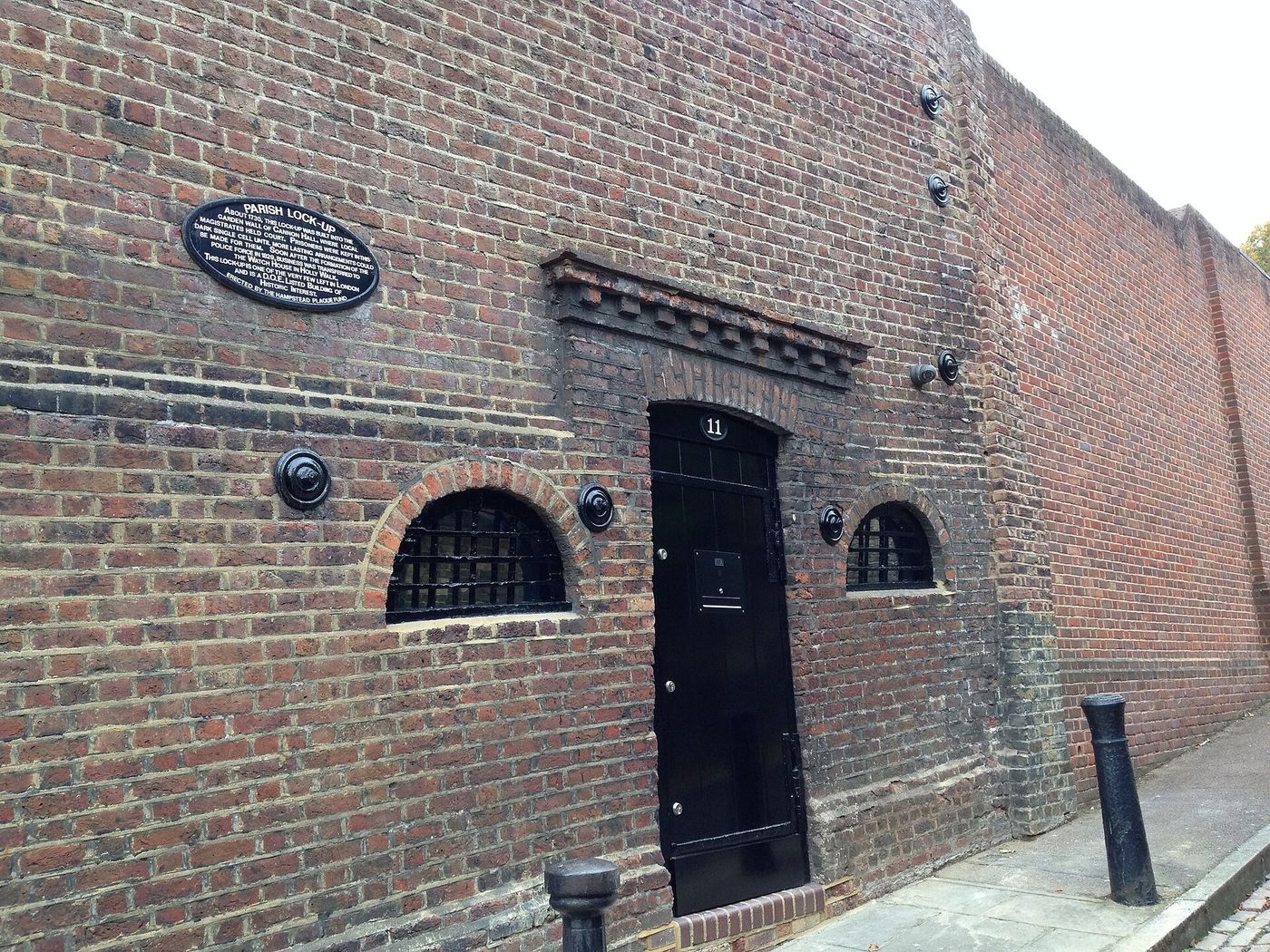

Stop twenty-three. The parish lock-up, in the wall on your left.
A heavy studded door, a barred slit at head height, and behind it a single windowless cell, built into the garden wall of the house above in about seventeen thirty. This is a village prison, and it is one of very few left anywhere in London.
The point of it is what did not exist yet. There was no police force. There was a parish constable, usually a shopkeeper doing a year of unpaid duty, and if he arrested you at ten at night there was nowhere on earth to put you. So you went in here, in the dark, until the morning, when the magistrates could see you. The magistrates sat in the house behind this wall, which meant the whole apparatus of law in Hampstead was one cell, one wall and one front room.
It stopped being used after eighteen twenty nine, when Robert Peel's Metropolitan Police arrived and the parish stopped having to improvise. The cell is now the entrance to somebody's very expensive house.
And the house it belongs to is Cannon Hall, which from nineteen sixteen was the home of Gerald du Maurier, the actor-manager. He was the first man ever to play Captain Hook, and in the same production the first to play Mr Darling, which is why to this day the two parts are usually doubled. His daughter grew up in that house and wrote Rebecca.
Which closes a circle, if you want it to. The boys who became Peter Pan are buried at stop two, twenty minutes back down the hill. The man who first played the villain lived behind this wall.
Free, visible from the lane at any hour, and easy to walk past.
Back down Cannon Place the way you came, then right and downhill into Well Walk. Two minutes. You will pass a small stone drinking fountain, and it is the reason the whole village exists.
51.56018, -0.17455 · where this is on a map