Track 22 · Water · 2:42
The whole walk as one file · the route as GPX · the podcast feed
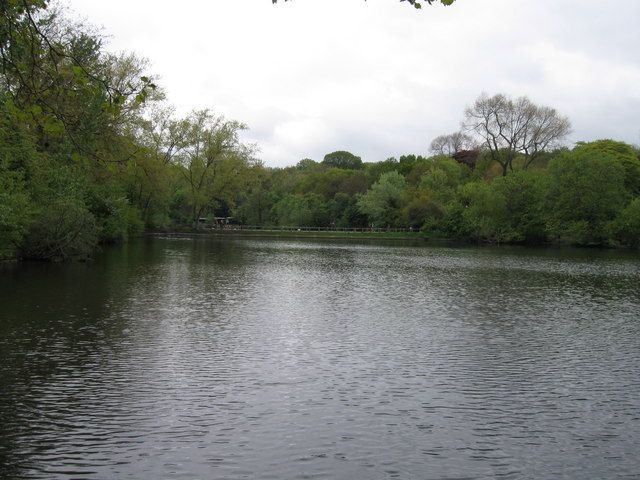

Stop twenty-one. The ponds, and the river underneath them.
None of these is a lake. Every pond on this Heath is a dammed valley, and the grass bank you are walking along is the dam. The water in them is the River Fleet, which rises in two arms up on this hill, one under this chain and one under the Highgate chain, and which meets itself at Camden Town before running down under Farringdon and out into the Thames at Blackfriars.
They also open English literature, in a way nobody expects. The first thing that happens in Charles Dickens's first novel is that Samuel Pickwick reads a paper to his club. The paper is about the source of the Hampstead Ponds, with some further observations on the theory of tittlebats. That is the joke Dickens chose to start with, and it only works because in eighteen thirty six a learned paper on these ponds was exactly the sort of thing a learned gentleman would write.
It was dammed for money. The Hampstead Water Company was incorporated in sixteen ninety two to supply London, and it spent the next century blocking these streams and piping the water down the hill in hollowed elm trunks. The ponds you swim in are a privatised seventeenth-century water utility that nobody ever got round to filling in.
Downstream, the Fleet was progressively covered over, turned into a sewer, and forgotten so completely that Fleet Street is named after a river most Londoners assume never existed. It is still down there. In heavy rain you can hear it through the gratings at Ray Street in Clerkenwell.
And then the modern argument. Because these are legally reservoirs, and because a dam failure here would send water down into Camden and Kentish Town, the City of London was required to rebuild the dams. It did, between twenty fourteen and twenty sixteen, at enormous cost, against a furious local campaign called Dam Nonsense. The result is the gentle grassy slopes you are standing on, which are engineered spillways pretending to be scenery. They look like they have always been there. That is the whole idea.
Free.
Carry on down to the bottom of the ponds and out onto South End Green. Take Keats Grove, which runs west off it. Three minutes. The white house behind the garden wall on your left is stop twenty-two.
51.55758, -0.16554 · where this is on a map